Overview:
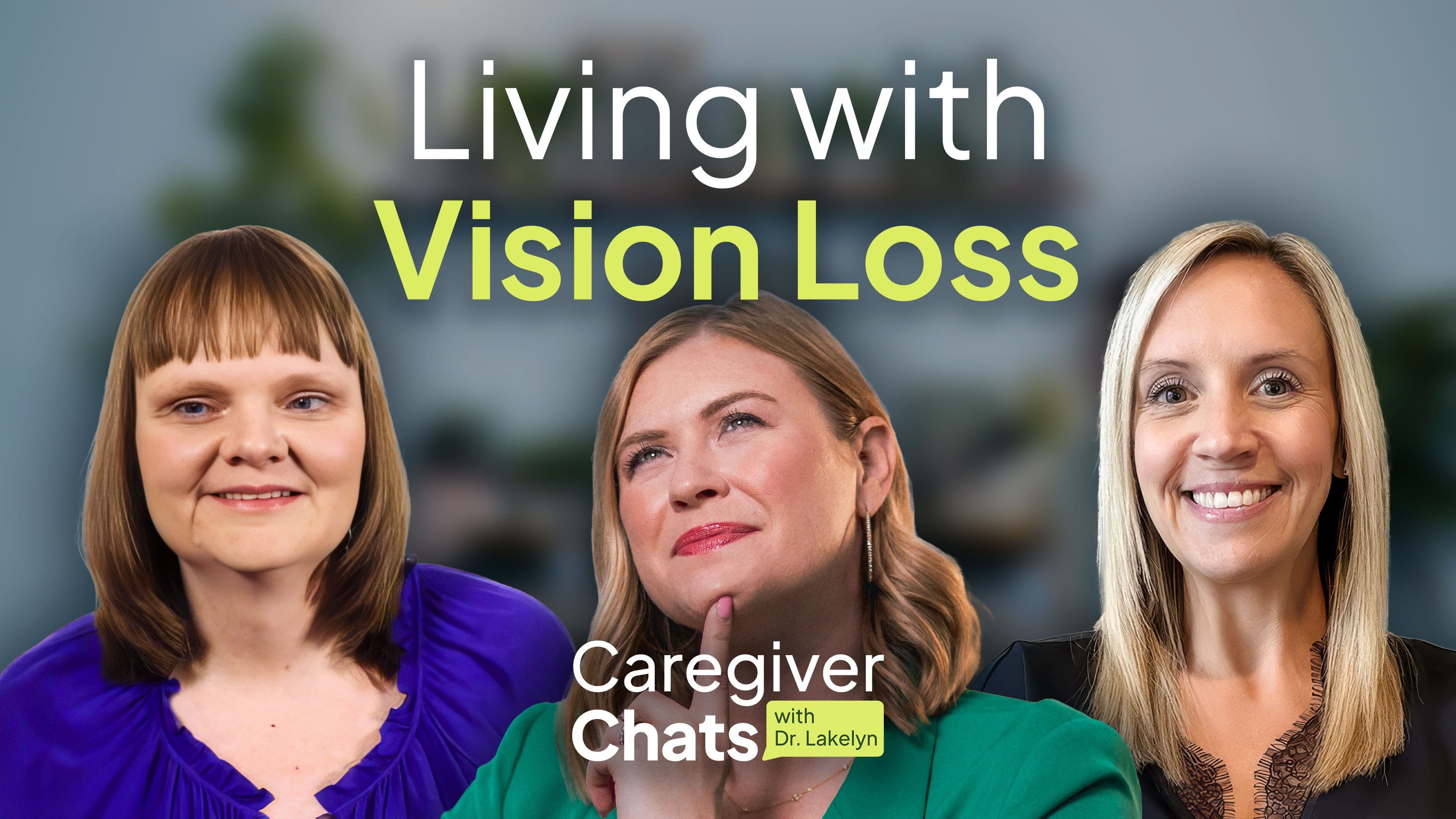
Dr. Lakelyn welcomes Cristi Stearns and Ricky Enger from Hadley, an organization that provides practical help, resources and community for adults adjusting to vision loss and the people who support them. Together, they discuss how family caregivers can support a loved one through vision changes while helping them maintain independence.
Cristi and Ricky explore both the emotional and practical sides of vision loss, from recognizing changes and navigating grief or isolation to adapting everyday activities like driving and reading. They also share tools, technology, peer support and resources that can help people living with low vision, and their families, build confidence and stay connected.
Highlights:
- Signs of vision loss and when to seek support
- How vision loss can affect independence and emotional well-being
- Tools and technology that can make daily life easier
- The value of peer support and connection
- Practical ways caregivers can support a loved one
Helpful links from this episode:
- Hadley: hadleyhelps.org
- National Federation of the Blind
- American Council of the Blind
- Foundation Fighting Blindness
Transcript:
Episode 83: The Surprising Truth About Navigating Vision Loss with Christi Stearns & Ricky Enger
Caregiver Chats • Brought to you by Home Instead
Host: Dr. Lakelyn Hogan Eichenberger | Guests: Christi Stearns & Ricky Enger (Hadley) | Duration: 45:31
Disclaimer: This transcript was generated using artificial intelligence. We strive for accuracy, but minor errors and slight timestamp differences may be present due to platform differences.
[00;00;00] Ricky Enger: People always think it's odd when I say this, but if there were ever a good time to be losing vision, as weird as that sounds, now is a great time because there are so many tools available to assist and make things easier. The technology is advancing so rapidly that things that wouldn't have been possible even ten years ago are much easier and much more approachable now.
[00;00;32] Dr. Lakelyn: Hi, Dr. Lakelyn here. Welcome to Caregiver Chats, brought to you by Home Instead. I'm so glad you're taking the time to join me. If you're a family caregiver looking for tips and resources, you've come to the right place. Don't forget to subscribe to the show on YouTube or your favorite podcast platform, and follow Home Instead on Instagram at HomeInsteadInc.
Vision loss can affect so many parts of everyday life, from reading and driving to preparing meals, managing medications, and staying socially connected. These changes can also happen gradually. Someone may adapt without realizing how much their vision has changed, or they may be hesitant to acknowledge it because of what those changes could mean for their independence.
Joining me today are Christi Stearns and Ricky Enger from Hadley, an organization that helps provide practical help, resources, and community for adults adjusting to vision loss and the people who support them. Together, we'll talk about the emotional and practical sides of vision loss and how caregivers can help a loved one adapt, stay connected, and maintain independence.
Christi and Ricky, thank you so much for joining me today on Caregiver Chats. I'm delighted to have you here.
[00;01;47] Ricky Enger: Thanks for having us.
[00;01;49] Dr. Lakelyn: The pleasure is mine, and I am so excited to talk more about this topic. We know that vision loss impacts so many people across the lifespan, but especially as people get into their older years. Family caregivers are often supporting a loved one who's experiencing vision loss, so I'm excited to dive deeper into this robust topic. There's so much we could cover, so we'll try to make the most of our time together today.
Before we dive deep into it, could you give us a little bit of background on how you both came to Hadley and what your areas of expertise are? Christi, I'll have you go first, and then we'll go to Ricky.
[00;02;32] Christi Stearns: Sure, absolutely. Again, thank you for having us. My background as a licensed professional counselor has really centered on helping people navigate difficult transitions and changes in their lives. Here at Hadley, I serve as the Director of Member Engagement, and a big part of my work is thinking about what happens when someone first reaches out to us: how do we help them feel understood, supported, and connected to the resources that are going to be most meaningful to them? Simply having a conversation with them, learning how we can help, and understanding what exactly they might be struggling with.
Something that I've really come to appreciate about vision loss is that it's not simply a change in eyesight. It can affect how someone sees themselves, their independence, their relationships, and even the future they imagine for themselves. We really try to address both sides of that adjustment—both the practical side and the emotional side.
I came to Hadley on a whim, actually. Strangely enough, my grandmother had both glaucoma and macular degeneration, and I wish at the time that I had known about Hadley and the resources that were available to her. When this opportunity fell into my lap, it felt like the perfect opportunity for me to help assist people with adjustments in their lives and learn more about something that someone so dear to me was struggling with.
[00;04;16] Dr. Lakelyn: Thank you so much, Christi, for sharing. I think it's wonderful that Hadley addresses this topic from multiple angles, and one of those is the practical side of things. Ricky, that's where your area of expertise comes into play, if I'm not mistaken. I'll let you introduce yourself.
[00;04;35] Ricky Enger: Yes, indeed. I came to Hadley because I have lived experience with vision loss. As I learned to do things while growing up, I saw things from both sides. There was myself learning the skills, and for me it felt very normal—I didn't know anything different. Then I observed other people watching as I learned the skills. A lot of times what I noticed was that there was a lot of fear, and a lot of, 'I could never do what you do,' and a lot of that unknown of what it is to have vision loss.
As I encountered other people who were going through vision loss, there was this sense of facing fear of the unknown. From my perspective, I knew that just on the other side of that, things weren't so bad. It was possible to do all of these things that initially seemed very daunting. I wanted to move people from that initial fear and trepidation to showing them that there are ways to do the things they love doing, maybe just in a different way. If those skills could be taught in an approachable way, I really wanted to be a part of that.
Hadley has been around for over a hundred years. They were well known in the blind and low vision community, and when I was invited to be a part of what Hadley was doing, I jumped at the chance.
[00;06;24] Dr. Lakelyn: Wonderful. Ricky, thank you so much for sharing your background and for helping people move past that fear. We're going to talk about the emotional side of vision loss throughout our discussion today, and that is such a key piece that, as you both mentioned, people don't always consider.
To level-set and get us started, Christi, you mentioned macular degeneration and glaucoma, but can we talk about the various eye conditions that people face? Especially as they approach that last third of life, what are the conditions that are more common as we get older, or the ones that you see most commonly at Hadley?
[00;07;06] Christi Stearns: Sure, I'd be happy to, and Ricky, if there are any that I miss, please feel free to jump in. We see people from all walks of life with many different diagnoses and eye conditions. Most commonly, I would say age-related macular degeneration, glaucoma, diabetic retinopathy, and retinitis pigmentosa—which actually is not necessarily age-related, but is common—and cataracts. But the most important thing to point out from our perspective here at Hadley is that regardless of their diagnosis, people experience many of the same practical and emotional challenges as their vision changes. Ricky, do you have any other diagnoses that you feel we often come across?
[00;08;02] Ricky Enger: The only other one I would throw in is stroke, whether that is a stroke within the eye or a stroke within the visual cortex of the brain. But exactly as you said, regardless of what the diagnosis is, you'll have some of the same experiences and you're going to use some of those same techniques and skills to adapt.
[00;08;31] Dr. Lakelyn: Thank you so much for giving us that broad overview. When we were prepping for the call, Christi, you talked about how for so many, vision loss is something that's more gradual. In the instance of a stroke, maybe it is a sudden onset, but can you talk to us a little bit about some of the signs that someone with gradual vision loss might experience? Since we have family caregivers listening, if they're seeing these signs in their loved one, it might be an indicator that it's time to get their vision checked and see if there's something else going on. Ricky or Christi, whoever wants to tackle this, we'd love to get a feel for what those signs are.
[00;09;15] Ricky Enger: You might see your loved one squinting a lot more, or maybe they're holding something they're trying to read way closer, way further away, or at a strange angle. You might notice them stepping cautiously, bumping into things they wouldn't have normally, or walking into a room and saying it's really dark when you're thinking, 'No, it's actually very bright.' Just pay attention to these little things.
Of course, there may also be things your loved one says directly related to vision loss: 'I'm having tunnel vision,' or 'I'm seeing halos, floating shapes, or distorted lines.' Be sure to pay attention to those comments as well.
[00;10;13] Dr. Lakelyn: That's really helpful. Christi, anything else to add to that?
[00;10;16] Christi Stearns: She hit the nail on the head there. Other things include struggles with driving, difficulties seeing in lower light as Ricky mentioned, or perhaps shying away from things that they ordinarily would have done—like going out to unfamiliar places. Tasks taking a little bit longer than they did before can also be common signs, which I'm sure we'll get into a little bit more later.
[00;10;51] Dr. Lakelyn: Those are all so helpful as initial signs. Withdrawal from activities that they once really enjoyed or engaged in can be a big indicator. There could be a number of things going on, but keeping up with regular vision checks is crucial. Family caregivers can encourage their loved one to get their eyes checked regularly to stay on top of these changes, especially if they are seeing any of those signs.
Sometimes we see hesitation on the individual's part to admit or bring up that they're struggling with their vision. Do you come across that often? Is there denial or resistance to reaching out for help with vision issues?
[00;11;42] Christi Stearns: Oh yes, we get that quite often. Even just hesitation to make that first call—whether to an organization like Hadley or even to their doctor. It can be a real struggle to acknowledge that there might be a problem. It's not necessarily that they're trying to hide it, but what does acknowledging a problem mean? What will that change? What will I lose? What will the next steps be that I have to face? It can be very scary for people to ultimately admit that. Ricky, any other points?
[00;12;26] Ricky Enger: You hit it right on the head. There's that feeling of, 'I'm not functioning optimally, so what does that mean?' People are afraid of change in general. We all like the status quo, so when you notice something is changing, admitting it means you now have to figure out next steps: What does this mean? What do I have to give up, if anything? What do I have to learn to do differently? It's human nature to put that off as long as possible so you don't have to confront it.
[00;13;09] Dr. Lakelyn: Most certainly. That is a really important perspective. Diving into the emotions that accompany vision loss, there is also an element of grief. This is a major life transition, and whenever there is a loss—whether of a person, functionality, or independence—grief is often experienced. Christi, you tune into the emotional aspects of this. Can you talk to us about grief? I imagine that's completely normal.
[00;13;44] Christi Stearns: It's absolutely normal, and it's essential for us to normalize that grief is an expected part of this process. It is a real loss. Having the space to acknowledge that, and recognizing that it is okay to have really big feelings about vision loss, is vital—not only for the individual experiencing it, but also for their caregivers and loved ones.
It is a process, and there can be a tremendous amount happening beneath the surface: fear, anger, frustration, and feelings of isolation all come along with adjusting, especially in the initial stages. Having the opportunity to express those feelings is critical.
Another thing I like to emphasize about grief is that it is certainly not linear. It can cycle through stages over and over again at any given time. Someone may feel like they are adjusting quite well to their new circumstances, and then they experience just a little more vision loss, or recognize they can't do something quite as quickly or seamlessly as before. That can take them right back to square one, where they start the grief process all over again. Giving yourself the grace and space to recognize and work through those stages is so important.
[00;15;35] Dr. Lakelyn: That's such an important point to emphasize—grief is not linear. Those setbacks, fear, or having to learn something new can be a blow to someone's confidence and self-esteem. Can you talk to us about that aspect, especially as it intersects with the loss of independence?
[00;16;09] Christi Stearns: When someone starts to recognize a change in their independence, or struggles to complete a task they once did easily—whether it's taking much longer or they can't do it at all—it can deal a huge blow to their confidence. They might think, 'I can't do this anymore. I'm incapable. How will I go on?'
It is so important for both the individual and their caregivers to encourage them to keep trying, even if it's just one small step at a time or trying a new method. Finding new ways of doing things ensures you don't completely shut down. As people discover they are still able to perform daily tasks, connect with others, and live their lives, they begin rebuilding that confidence.
[00;17;22] Dr. Lakelyn: Thank you so much for sharing that. I'd love to segue into practical everyday tips that help restore confidence and maintain beloved activities—perhaps just approached in a different way, as Ricky noted. Ricky, what are some of the most common challenges you see, and what practical tips do you start people out with?
[00;17;52] Ricky Enger: One thing people often struggle with is seeing things clearly in their environment. With a vision change, many factors come into play, and sometimes just having the right lighting makes a huge difference. If you have become light-sensitive, making environmental adjustments to reduce glare helps tremendously. Conversely, if you need things brighter to see, task lighting focused directly on what you are doing—whether reading, crocheting, or cooking—makes it much easier.
Reading is another major challenge, whether reading for pleasure, sorting through mail, or reading product instructions. Many people know about handheld magnifying glasses, but there are also digital and video magnifiers. These allow you to change the background contrast and color scheme to match your specific vision needs, as well as zoom in and out dynamically.
For everyday household items where controls are hard to identify—like finding a specific button on the microwave or setting an oven dial—you can use bump dots. Bump dots are a simple, low-tech solution: small, raised, often brightly colored adhesive dots placed directly on key buttons, such as the start button on a microwave or the channel rocker on a remote. They provide clear tactile feedback and visual contrast, making appliances immediately accessible.
[00;20;42] Dr. Lakelyn: I love that you brought up bump dots, Ricky. Before working at headquarters, I worked in a franchise setting and had a client who utilized bump dots on her microwave and stove. They were an absolute game-changer in helping her maintain her independence. Our Care Professional would come in to help prep vegetables and fruits for the week, and with those bump dots and prepped items, she maintained her cooking independence.
I love that Hadley helps people discover both low-tech and high-tech solutions while providing peer connection and emotional support. When someone reaches out to connect with Hadley, what does that peer-to-peer support look like, and what can people expect when they reach out?
[00;22;01] Christi Stearns: When making that first call, it can feel daunting. Many callers have never spoken to anyone else about their vision loss before, or perhaps it's the very first time they are admitting it to themselves. They may have been urged by a loved one or referred by a medical professional.
When they call, they speak with a live person—something we pride ourselves on. Someone on our team, like myself or Ricky, will have a conversation with them. It can be as brief or as long as they need. We get to know where they are on their vision journey and what they need. You don't have to figure everything out in that single conversation; we simply help identify the best first steps.
Often that means connecting with others, whether through our peer-to-peer program or one of our small support groups where participants discuss the grief and emotions surrounding vision loss. If someone isn't quite ready for one-on-one or group interaction, we offer podcasts: 'Insights & Sound Bites,' which features short member stories about overcoming challenges, and 'Hadley Presents,' hosted by Ricky Enger, where she interviews professionals about vision topics and assistive technology. We also provide practical workshop tutorials covering skills like bump dots and labeling, allowing people to learn at their own pace.
[00;24;56] Dr. Lakelyn: That's fantastic that you provide multiple entry points. Reaching a live person is so rare today, and your team brings such warmth and approachability to this experience. What is particularly exciting is that you recognize caregivers need support too. Could you share more about the support services you are developing for caregivers?
[00;25;44] Christi Stearns: As I became more involved with our emotional support services and support groups, I kept noticing that vision loss affects the entire household—family, friends, and support networks. Caregivers need opportunities to refill their own cups, as caring for someone can be emotionally draining, and they need to understand how best to assist their loved one.
We recently developed our 'Family & Friends Adjusting Together' support group under our broader support umbrella. While 'Adjusting and Coping Together' serves individuals with vision loss, this companion group offers a six-week space for family and friends—spouses, adult children, or close friends—to connect with others facing similar dynamics. Our initial pilot group was wildly successful.
Caregivers are also encouraged to explore all of Hadley's free resources, workshops, and podcasts. When my grandmother was losing her vision, I didn't know anything about bump dots; educating family members on these tools transforms how they support their loved ones.
[00;28;22] Ricky Enger: Christi ended on the perfect note regarding caregiver education. Often neither the individual nor their caregiver has ever met anyone else with vision loss, so there's an instinct to become overly protective. A caregiver might say, 'Don't pour that hot coffee; I'm afraid you'll burn yourself.' That reaction comes from love, but also from not knowing safe techniques. By using our learning resources, caregivers discover safe, proven methods for everyday tasks, which gives their loved one agency while giving the caregiver peace of mind.
[00;30;08] Dr. Lakelyn: The coffee pouring example is spot on. Caregivers naturally want to protect and assist out of love, but over-assisting can inadvertently diminish independence. Having the skills to perform a simple task like pouring coffee independently means so much. Are there any other practical tips caregivers should keep in mind to help their loved one without stepping in too much?
[00;31;02] Ricky Enger: First, agree on organization: 'A place for everything, and everything in its place.' Moving an item—like medication or spices—can be far more disorienting than you might realize.
Second, anchor learning around personal, concrete motivations rather than generic tasks. Instead of saying, 'You have to master your smartphone for emergencies and appointments,' focus on what they miss: 'Let's learn how to zoom in or turn on voice-over so you can get back to playing your morning word games.' When the goal aligns with personal joy, learning feels far more rewarding.
Third, practice new skills in low-stakes, stress-free environments. Don't attempt to learn a smart assistant like Amazon Alexa under time pressure. Pick a calm afternoon to set up medication reminders like, 'Alexa, remind me to take eye drops at 6:00 PM.' If the first attempt is clunky, there's no severe consequence. Making room for low-stress practice sets the stage for lasting confidence.
[00;34;22] Dr. Lakelyn: Those tips are so practical and thoughtful. Beyond Hadley, are there other national organizations or specialist referrals you recommend caregivers and individuals connect with?
[00;35;08] Ricky Enger: First, when seeing an ophthalmologist or optometrist, ask for a referral to a low vision specialist. While they don't perform surgery or prescribe medicine, they evaluate your functional vision and recommend customized tools—such as specific optical magnifiers, glare-reduction lighting, bump dots, or high-contrast stair tape.
Second, connect with your state's Division of Services for the Blind. Many people assume they aren't eligible because they aren't totally blind, but vision loss is a spectrum. If functional vision impairs daily activities, their programs offer local training, in-home assessments, and assistive technology support. Because state agencies often have waiting lists, reaching out early is key.
[00;37;38] Christi Stearns: I'd also recommend the National Federation of the Blind (NFB), the American Council of the Blind (ACB), and the Foundation Fighting Blindness, which focuses heavily on research. Additionally, look into your state's Older Individuals Who Are Blind (OIB) program. Their directories list state resources alongside regional nonprofit partner organizations.
People often hear the word 'blind' and hesitate because they retain usable sight. Please reach out early so you can build your toolkit proactively rather than under crisis.
[00;39;20] Dr. Lakelyn: That advice regarding low vision specialists and community clinics is invaluable. Having specialists guide you through specialized storefronts of large-print calendars, talking clocks, and tactile aids takes out the guesswork. We will be sure to link all these organizations in our show notes.
As we conclude, what final words of encouragement would you offer to caregivers and individuals navigating vision loss?
[00;40;59] Ricky Enger: I'll conclude where I began: while confronting vision loss brings real fear and uncertainty, there has never been a better time in history to adapt. Assistive technologies and accessible resources are advancing rapidly, making everyday life far more approachable than was possible a decade ago. Grieve the changes as you need to, but know there is immense hope. You can continue doing what you love, and you will discover just how resilient you are.
[00;42;26] Christi Stearns: You do not have to walk this journey alone. Organizations like Hadley and the supportive communities we discussed are here to walk beside you. Take that step and make the call—even if you have to pick up the phone five times before dialing. We are here to listen and help you through each adjustment.
[00;43;21] Dr. Lakelyn: Thank you both so much. The warmth, dedication, and expertise you bring to Hadley are remarkable. All of Hadley's resources and courses are completely free to the public, so please take advantage of their website, video workshops, and support lines.
Thank you for listening to Caregiver Chats, brought to you by Home Instead. Vision loss does not mean giving up independence or the activities that bring joy. If you need in-home care to support your caregiving journey, visit homeinstead.com. Take good care of yourself while caring for others!
To learn more about this podcast and to subscribe to our caregiving newsletters, visit www.homeinstead.com/caregiverchats. Share your thoughts, experiences and ideas by emailing Dr. Lakelyn at caregiverchats@homeinsteadinc.com.
Like, subscribe, rate and review this podcast on your favorite podcast platform.
Follow us on social media:
- Instagram: @caregiverchatspodcast | @homeinsteadinc
- Facebook: facebook.com/homeinsteadinc
- YouTube: youtube.com/@HomeInsteadInc
- TikTok: tiktok.com/@homeinstead.inc