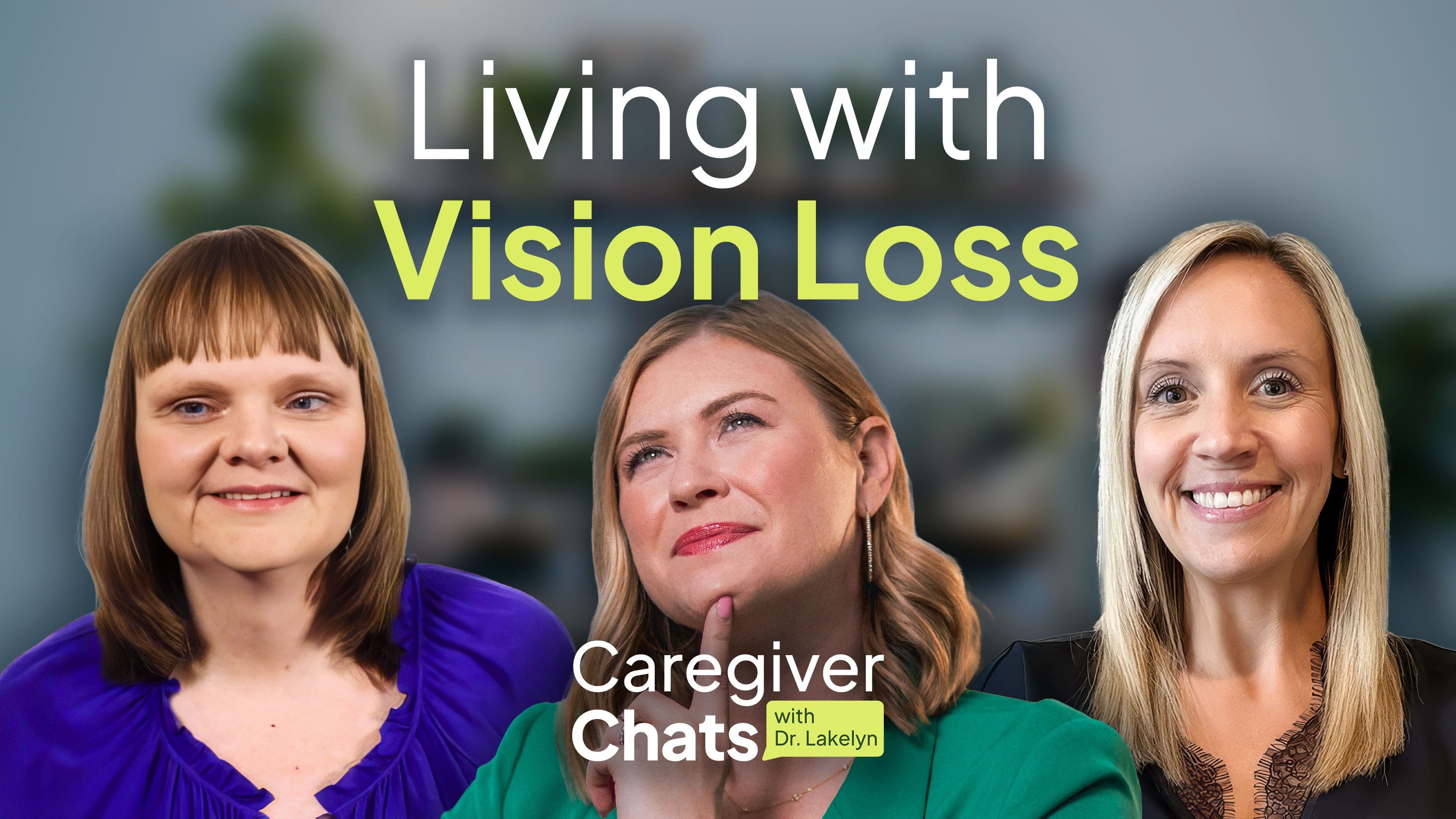
Overview:
For nearly 40 years, audiences have known Jennifer Grey as Jeanie Bueller, the frustrated older sister in Ferris Bueller's Day Off. Now, she's returning to the role for Home Instead's Save Jeanie holiday campaign, bringing a familiar family dynamic into a new chapter of life: caring for older parents.
But Jennifer's connection to caregiving goes far beyond the screen.
In this special episode of Caregiver Chats, Jennifer joins host Dr. Lakelyn Eichenberger for an honest conversation about her own experience caring for her parents. She shares the emotional challenges of watching loved ones grow older, the pressure of being the family member everyone counts on and the unexpected gifts that can come from sharing the responsibility of care.
Jennifer also reflects on the joy of reuniting with Charlie Sheen for the campaign, why Jeanie's frustration feels so familiar to family caregivers and how asking for help has changed her own caregiving journey.
Highlights:
- What it was like for Jennifer to revisit her iconic Jeanie Bueller character nearly 40 years later.
- How caregiving responsibilities can grow over time, often without families realizing it.
- The emotional challenges of caring for older parents, including grief, guilt and the desire to do everything right.
- Why sharing responsibilities with siblings and seeking outside support can make caregiving more manageable.
- The importance of preserving a loved one's dignity, independence and sense of self.
- Why taking care of yourself is an important part of caring for someone else.
You Don't Have to Do It All Alone
As Jennifer shares, caregiving can be one of life's most meaningful experiences, but it can also be overwhelming. Finding support doesn't mean stepping away from someone you love. It means making room for the care they need and the relationship you want to have with them.
Watch or listen to the conversation, and discover why it's time to help save the Jeanies in all our lives.
Helpful links from this episode:
- Explore the Save Jeanie campaign: savejeanie.com
- Learn more about home care: homeinstead.com
Transcript:
Episode 84: Jennifer Grey on Caregiving, Family and Learning to Ask for Help
Guest: Jennifer Grey | Host: Dr. Lakelyn | Topic: Save Jeanie Campaign & Family CaregivingDuration: 30:02 | Brought to you by Home Instead
Disclaimer: This transcript was generated using artificial intelligence. We strive for accuracy, but minor errors and slight timestamp differences may be present due to platform differences.
[00;00;00] Jennifer Grey: All of a sudden, it just becomes this very almost surreal switch of being their caregiver. If you're lucky enough to be around for your parents in old age—if they have been able to be with you, taking care of you for the first 50 years of your life—all of a sudden you have this incredible gift that they're still here, but nobody prepares you for the job ahead.
[00;00;30] Dr. Lakelyn: Hi, Dr. Lakelyn here. Welcome to Caregiver Chats, brought to you by Home Instead. I'm so glad you're taking the time to join me. If you're a family caregiver looking for tips and resources, you've come to the right place. Don't forget to subscribe to the show on YouTube or your favorite podcast platform, and follow Home Instead on Instagram at @homeinsteadinc.
Tell me if this sounds familiar: Taking care of Mom or Dad started with picking up the medications at the pharmacy and grabbing some groceries. Then Dad needed a little more help getting to his appointments after he stopped driving. Then he needed even more help to stay comfortably at home, and it started feeling like taking care of a parent became a full-time job. All this time, the sibling help you needed was nowhere to be found. If this sounds like you, then you might be a Jeanie.
That familiar family dynamic is at the heart of Home Instead's new holiday campaign called Save Jeanie. The campaign brings back Jeanie, the responsible sibling from Ferris Bueller's Day Off—only now, decades later, she's the one managing her aging parents' needs while Ferris is nowhere to be found. It's funny and nostalgic, but also reflects the reality so many family caregivers experience. I'm thrilled to welcome Jennifer Grey, who returns as Jeanie in the Save Jeanie campaign. Today we'll talk about what it was like to step back into this beloved character, Jennifer's own connection to caregiving, and what she hopes caregivers will take away from Jeanie's story.
Hi, Jennifer. Thank you so much for joining me on Caregiver Chats. I am so excited to have you here.
[00;02;08] Jennifer Grey: So excited to be here, to be perfectly honest. I love talking about this subject.
[00;02;13] Dr. Lakelyn: Oh, wonderful. Well, I'm excited to dive in, get to know you a little bit better, and learn about your experience on the set of Save Jeanie, which is Home Instead's commercial that you just shot with us. It's so fun to see Jeanie step back into this role from Ferris Bueller's Day Off, kind of 40 years after you originally filmed the movie.
[00;02;37] Jennifer Grey: A 40-year thing is just so strange. But yes, it has been.
[00;02;43] Dr. Lakelyn: So, what was it like to return to that role and step back into the character of Jeanie?
[00;02;48] Jennifer Grey: Well, it was such a blast because, number one, Ferris Bueller is one of my favorite gigs I've ever done. I have such fond associations with John Hughes and the movie, and with Jeanie, who I have a very soft spot and a lot of empathy for—because she's not like that for no reason. It was so great to be able to literally go back. It felt like we were time traveling, because I hadn't seen Charlie [Sheen], who I am so fond of and always have been. I can't remember the last time I saw him—maybe 40 years? I don't know, 35 years. We had been really good friends for years before that, and there was no reason for us not to be friends after that. To just get to be with him, it was like we just had a little bit of old-age makeup on, but we were the exact same.
[00;03;49] Dr. Lakelyn: Like they just put a little latex around you.
[00;03;53] Jennifer Grey: It was incredibly heartwarming for me, and also because he's so funny and so smart. The reunion was so beautiful, and it was definitely one of the incentives for me doing this campaign—for us to be able to riff on the police station scene and go back. It's just such a clever campaign. I was very impressed with what Home Instead did to create something that had so much levity and humor when we're talking about things that are hard. I think it's smart because it offsets the heaviness or the weight of this particular subject.
[00;04;42] Dr. Lakelyn: Yeah, for sure. And I would imagine for those who are caregivers, seeing such an iconic character like Jeanie fast-forward in life—from her days in the original movie to now in this new life stage of caring for her parents and having to do all of these caregiving tasks—brings some levity to it by relating it to someone so many people know. Ferris Bueller's Day Off is the most iconic movie; everyone knows it. To bring those things together, I think you're right—it's a unique way to talk about this topic that touches so many people. Caregiving really is something that if it hasn't happened to us, it's going to.
[00;05;24] Jennifer Grey: If you're lucky enough to be around for your parents in old age—if they have been able to be with you, taking care of you for the first 50 years of your life—all of a sudden you have this incredible gift that they're still here, but nobody prepares you for the job ahead. You just can't imagine it because they're so robust and high-functioning and they've always taken care of you. Then all of a sudden, it just becomes this almost surreal switch of being their caregiver. Even if you're a mom like I am, and even if you're a very caretakery person—it's just my vibe—if you are that person, then you automatically assume that role, or people assume that's what you should be doing.
When I look at Jeanie in this commercial, or back in the movie originally, she is so frustrated because she's such a good girl, she does everything by the rules, and she's so angry that she's not rewarded for being good. Meanwhile, Ferris just seems to do nothing he's supposed to do—he does everything that's selfish, fun, and not being good—and I think it just makes her crazy. So she would be the natural caregiver in this situation. Absolutely. And the fact that she's so enraged when we see her in this spot is so funny, because the last time we saw her she was like that, and now we see her like that again.
I believe the reason she's at her wits' end and jumping out of her skin enraged is because she has taken on too much. It just became too much for her, and it's too much for one person ever. I had never even asked my brother to participate in caregiving because that was my role in the family—the fixer, the hero child. Very typically, the firstborn daughter is the person who becomes next in line to take care of everybody. There's the frustration of a person who has assigned themselves that role because it makes them feel like they're the only one who can do it right, or the only one they think can actually follow through. I was robbing my brother of that opportunity for so many years because I just assumed that role, and everyone in the family assumed that was me. Then all of a sudden, my brother is showing up like a champ—incredibly, like I've never seen—and his relationship with my dad is just so beautiful and something they never had before this moment. So there are all these gifts that come with the difficulties of late-in-life stuff.
[00;08;34] Dr. Lakelyn: Well, Jennifer, I think you brought up so many great and relevant points. When we talk about caregiving, we often see that one child step into the role, yet so often family members don't see themselves as a caregiver. They just see themselves as the good daughter, the savior, the responsible one stepping into that role—they don't identify as a caregiver. What we find is that often, if you don't see yourself as a caregiver, then you don't know all the resources out there. That's one of the reasons we wanted to do this campaign and this commercial with you: to take popular culture and bring home care into the conversation to help people realize there are support services out there that can help family caregivers. I would be curious to know, Jennifer, were you familiar with Home Instead or home care as an industry before being asked to do this?
[00;09;23] Jennifer Grey: Well, I wasn't familiar with Home Instead until you guys came to me, though I am very familiar with seeking outside help. Maybe 10 years ago with my mom—it doesn't have to be a crisis—her life was changing and I didn't have the resources or the bandwidth. At the time, I still had my kid at home, so it was that sandwich generation where you still have kids. It's a very odd dilemma because you love your parents so much and they've given everything to you, so all you can think of is, "I have to do everything I can possibly do for them," because how could you not?
If you're not aware that there are social workers, people you can hire, and agencies like Home Instead—which I've never used personally, though I have gone into that world and used part-time help. It's not about a full-time thing; it's just knowing that resources are available. And the relief you feel when it's not all on you—when you can share it with a sibling you never thought would show up, and suddenly they show up and you're like, "What a gift this is for everybody!"
[00;10;52] Dr. Lakelyn: Yeah.
[00;10;53] Jennifer Grey: It's such a rewarding job, but if it's on one person, you can get very frayed around the edges. There are also a lot of health issues and self-abandonment that come with this job that are epidemic, from what I understand. People's health really suffers because it's not a sprint, it's a marathon—and it actually grows in demand with time. It's not like you fix them and then they're good. It is a slow decline or a quick decline, but it is ongoing and it grows in terms of what is requested and what their needs are. It's almost like going from a toddler to a baby, and thinking about how much more an infant needs. It's an interesting thing that nobody wants to think about or talk about because it's so painful, frightening, and mysterious, and we don't know what the timeline is.
[00;12;00] Dr. Lakelyn: The old saying is true: you can't pour from an empty cup. Let's be real—as a family caregiver, taking a break is often easier said than done. Whether you're caring for a loved one, managing stress at work, taking care of your children, or maybe all three, everything adds up. Caregiver burnout is real and can affect you in more ways than one. When you need a break to rest and recharge, Home Instead is here to step in with personalized respite care. Whether it's a few hours a week to run errands or longer-term support, our Care Pros help support your loved one's safety and engagement. Home Instead is here to help support your family. Schedule a free care consultation at homeinstead.com.
Well, Jennifer, gosh, you're talking about so many themes that we discuss all the time on the Caregiver Chats podcast—how caregiving is so often that marathon, not a sprint. I call it "caregiver creep" because over time, the role just creeps up on you. You take on a little bit more and a little bit more, and before you know it, it's all-consuming and your needs go on the back burner. Then, if you're sandwiched between caring for your own children and your aging parents, you have that tension, and a lot of times caregivers are also working. It's so complex and layered, so that extra support can be so helpful.
As you mentioned, sometimes people don't know that those supports are out there, and I think sometimes people also assume you have to jump into full-time support. No—you can layer it in over time; as the needs grow, the service can grow along with them. I think you hit the nail on the head in so many ways when talking about caregiving, and I love what you said about inviting your sibling in. Sometimes we make assumptions that people don't want to help, or maybe aren't capable or won't do a good job.
[00;13;54] Jennifer Grey: Or whatever. Also, when you were talking about that, I was thinking about this shame piece that I feel—that it should be me doing everything. But I think back to my parents: they had nannies and housekeepers, they had each other, and it was different. When you're having a baby, everyone you know is having a baby, and you're all coming together talking about the difficulties of a newborn, breastfeeding, or sleep, and you have this community. I can't speak for anyone else, but in my experience, a lot of my friends who are my age, their parents are gone. I'm one of the lucky ones—my mom just passed away this past summer at 94, and my dad is still very much well and alive at 94.
[00;14;50] Dr. Lakelyn: 94!
[00;14;51] Jennifer Grey: And they all say, "Oh, you're so lucky, you're so lucky." They never really did the caregiving because probably their parents died quickly, or a long time ago, or in another state. I felt very alone. I did not have a community of people going through what I was going through. Everyone would say to me, "Oh my God, you're so great," and I was like, "I am so confused about how to navigate this path." It's almost like a dilemma where I can't not do it, and I can't do it to the level that I want to do it—which is wanting to be perfect. And there is no perfect.
[00;15;38] Dr. Lakelyn: Well, I love the moment in the commercial where you sit down next to Charlie Sheen and he says, "Well, does it have to be you?" And you kind of have this aha moment. He says, "Well, call Home Instead," after you say something to the effect of, "Well, if it's Ferris Bueller, I'm gonna scream." Charlie says, "No, call Home Instead," which again speaks to so many caregivers out there—at least we hope it does. Those caregivers who are feeling at their wits' end suddenly realize, "Oh, there is someone I can call who has been doing this for a long time." Home Instead has been around for over 30 years, and we're pretty much everywhere here in the U.S. and in Canada. Hopefully it'll draw people to check out the service and get help and support, whether it's through us or through another resource. That's really the goal of this campaign: to make the Jeanies out there feel less alone.
[00;16;32] Jennifer Grey: Especially—I love that it's a holiday spot, because when people go home for the holidays and see the state of how their parents are living, or see that something has declined while they're on the other side of the country, there's powerlessness, fear, shame, and confusion. I think the idea of people coming together, seeing where things are, and realizing, "I don't have to be angry at everyone else in my family"—or, if you're the only one, feeling like you have to abandon your own life—is huge. You can reach out, and there are so many people. It's not like you have to take the first person they give you. You can interview people, find a good fit, and find someone who feels like they're not a stranger—like they speak a similar language. It's like when people say, "I can't talk to a psychiatrist about my problems." You have to find the right person you want to tell what's going on. It's very personal, and there are so many wonderful people doing God's work, in my opinion.
[00;17;48] Dr. Lakelyn: The nurses in the hospital—
[00;17;50] Jennifer Grey: The people who are caregivers for elderly people—there is so much love there. The people who are drawn to that profession are quite impressive. I always say to Julie, who's been helping me with both my parents for years, that I am grateful beyond words, because she's really doing a service that allows me to continue living my life, gives me support, and leads the way.
[00;18;21] Dr. Lakelyn: That's wonderful. And you are a caregiver, whether you've ever called yourself that or not.
[00;18;27] Jennifer Grey: Definitely, yeah.
[00;18;29] Dr. Lakelyn: Okay, good—you identify as a caregiver. That's step one. I know this is a podcast all about family caregivers, so would you be willing to share a little bit more about your caregiving journey? You mentioned you've supported your mom and your dad, and you have the support of Julie—what does caregiving look like today, and how does it show up in your life? Because we know it's such a common thread in most families.
[00;19;02] Jennifer Grey: I think the way I can show up—I mean, my mom was in the ER all the time this past year. She had cancer, and we didn't know. I was that number-one call. I was the person who would go into the ER and go into the assisted living facility to see what was happening, and inside I felt just heartbroken, horrified, and so sad. At the same time, my mom didn't see that side of me; she saw me come into the ER, get some blankets, talk to the doctors, and make sure everything was handled. There is so much to do when people get to be 94.
If you are that person in the family who everyone assumes has got it—"She's so good, she takes care of everything, you always know"—my parents always say to me, "You always know everything. How do you know everything?" And I'm like, "I really don't. I'm on ChatGPT a lot pretending to be a doctor!"
[00;20;20] Dr. Lakelyn: Pretending to be a doctor!
[00;20;22] Jennifer Grey: I'm always looking for solutions—I'm on Claude putting in every single symptom. I literally have been able to diagnose things; you have to watch doctors.
[00;20;36] Dr. Lakelyn: You have to really advocate for your loved one. You're always the advocate.
[00;20;40] Jennifer Grey: Yeah, because it's a machine. Hospitals and ERs are a machine, and only you know your loved one the way you know them. Sometimes it's just about helping my mom get rid of those chin hairs—that would bother her more than the fact that her hand was curled up and she was 85 pounds. She'd point to them, and I'd come in with a tweezer.
[00;21;06] Dr. Lakelyn: Get those things! Because the truth is, that's important stuff—to feel fresh, to feel like yourself.
[00;21;13] Jennifer Grey: To feel like yourself. You're still you in there—your inherent value that you're born with. This is what I believe: you're born, this soul comes into this baby's body, and it's there throughout. When you die, it's still the exact same thing—this inherent value as a human, soul, whatever that is. The outside stuff falls apart, it crumbles, it gets beaten up depending on whatever you've been doing for those years, and the value is in there always. The rest of it is just stuff to manage, and to remember they're still in there—still that little boy, that little girl.
[00;22;11] Dr. Lakelyn: I think that's so important, especially in the work that we do at Home Instead. We are always training our Care Pros on dignity and respect. That person is still a person. The care they need might have changed over time—their needs might have changed, their abilities—but they're still a person. Helping them connect to that personhood, even through little things like a beauty routine, shaving every day, putting on that red lipstick, or putting on a suit and tie, matters so much.
[00;22;39] Jennifer Grey: My mom would put on that Hermès scarf that I gave her years ago, and she was just so elegant. Her skin was so gorgeous, and she'd be like, "I need a facial." I'd say, "Mom, you really don't need a facial. Your skin is better than mine—it's better than everyone's. I'm looking at it and it's gorgeous." But so many things are taken away from them: the car keys, the house, and all of a sudden they say, "I don't want to use a walker." You say, "Okay, well that's a really hard adjustment because you've always been so physically spry, and the cane feels okay, but the walker is no good. Truth is, you're going to fall and end up with a broken hip in a hospital with complications—it's just the beginning of the end." So then you say, "Even if you don't feel like it, let's find you the coolest walker."
[00;23;31] Dr. Lakelyn: The coolest walker!
[00;23;32] Jennifer Grey: When my dad finally went, he said, "I found this one that I think I could use." For years it was, "That's not me," and I was like, "Yeah, it's not you as you see yourself, but look how gorgeous you are. If you stop walking, it's over, dude. We've got to keep you moving." It's when you start becoming sedentary and not moving that things decline. It really comes down to sleep, walking, food, and not being isolated.
[00;24;04] Dr. Lakelyn: Oh, well, gosh, you brought up so many great points. As our loved ones grow older, it is hard for us to watch them go through these changes, but it's also hard for them to accept the changes that are happening. Caregivers have to do so many different tasks for their parents, and then they also play a little bit of a counselor role too—navigating the emotions and helping them through it. Not only that, they're also dealing with their own emotions, what we talk about as anticipatory grief. You're grieving some of the loss you're witnessing your loved one experience, or especially in cases where there might be cognitive decline, a caregiver might be mourning that as well. There are so many big layers to caregiving.
[00;24;51] Jennifer Grey: When you're actually grieving them while they're still here—because you're grieving who they were, who they were to you, and how you saw them. Oh, it makes me cry thinking about it, because it's painful and precious at the same time. You want to look away, you want to not deal with it, and then you have to, and then you're happy you did. I wish people talked about that stuff more, because professional caregivers are very good at teaching, too. They teach you: don't correct them; what do you do when they act paranoid and think you're after them; or how to handle sundowning. It's the Wild West for people who aren't professionals. We're like, "Oh, what do we do? I don't recognize this landscape at all."
[00;25;48] Dr. Lakelyn: Especially if you've never been in the role and you're really learning as you go. For sure.
[00;25;54] Jennifer Grey: For sure.
[00;25;55] Dr. Lakelyn: Well, Jennifer, this has been such a wonderful conversation, and thank you for being so open and sharing. To kind of wrap us up—tie it with a bow, perhaps—what message would you leave the Jeanies of the world with as they go forth in their caregiving journey?
[00;26;14] Jennifer Grey: My message would be, number one: put the oxygen mask on yourself first, like they say on the plane—do that before your loved ones. You don't have to carry the responsibility alone. You're not alone. Seek help, whether it's from your peers or the internet, or anybody who has walked this path before—because most people have, and it's not talked about enough. I wish it were more in the zeitgeist, because there are so many people now who are living much longer than they ever did, and as a result, there's going to be a lot more caregiving. The good news is we get to have them longer, and the bad news is we become caregivers longer.
It is a very purposeful and profound job—one of the most impactful jobs—and how we handle it and care for them matters. But in order to be our best selves, I can't imagine anyone not enlisting help from a sibling, a friend, and an agency or a place where you can get support, because you will be a better version of yourself for them. It really is essential that you take care of yourself, because it is a slog—a beautiful slog—and getting help is necessary in order to last.
[00;27;58] Dr. Lakelyn: Thank you so much, Jennifer. What a wonderful way to wrap up our conversation. Thank you for joining me, and thank you for being part of this Home Instead campaign, Save Jeanie. I can't wait for that commercial to really help elevate this conversation. As you said, we need to be talking about it more, so hopefully it creates some good buzz, and Jeanies all over the world will see themselves in that character and, most importantly, reach out for help. And the people who think she's just a raging maniac haven't done the work.
[00;28;30] Jennifer Grey: If you've been in that position, you understand what it does to your nervous system. It's not pretty. So there are options, and there are ways to support yourself and be able to show up in a way that feels like your best self.
[00;28;48] Dr. Lakelyn: Well said. Thank you so much, Jennifer.
Jennifer, thank you so much for joining me today and for helping shine a light on family caregivers through Save Jeanie. I hope this conversation reminds every caregiver listening that support is available, and that asking for help is a sign of strength, not a failure. You do not have to carry every responsibility alone. Whether that means starting an honest conversation with a sibling, reaching out to a friend, or exploring care options, even one small step can make a meaningful difference. You can learn more about the Save Jeanie campaign at SaveJeanie.com.
If you found today's episode helpful, please subscribe, leave a review, and share it with another caregiver who could use this reminder. Be sure to connect with me on Instagram at @homeinsteadinc for episode updates, caregiving tips, and more. Thanks for listening, and please remember to take good care of yourself while you care for others. Caregiver Chats is brought to you by Home Instead. If you're looking for in-home care to support you on your caregiving journey, please visit homeinstead.com to learn more.
To learn more about this podcast and to subscribe to our caregiving newsletters, visit www.homeinstead.com/caregiverchats. Share your thoughts, experiences and ideas by emailing Dr. Lakelyn at caregiverchats@homeinsteadinc.com.
Like, subscribe, rate and review this podcast on your favorite podcast platform.
Follow us on social media:
- Instagram: @caregiverchatspodcast | @homeinsteadinc
- Facebook: facebook.com/homeinsteadinc
- YouTube: youtube.com/@HomeInsteadInc
- TikTok: tiktok.com/@homeinstead.inc