Understanding the senior care issues you and your family face everyday is deeply important to Home Instead Senior Care. To help you understand some of the issues millions of elderly people and their families face every day, please read our Senior Care Issues.
The Home Instead Senior Care franchise network is a trusted resource for thousands of health care professionals and families like yours. We've identified elderly care resources you can trust as you look for the appropriate elder care for your loved one.
Caregiverstress.com is an informative web site offering ways to cope with caregiver stress allowing your family caregiving role to be more rewarding. Take the free, stress assessment test to identify the level of stress you're currently feeling as a result of the senior care you're providing. Based on your stress level, targeted senior services resources will be provided to you as a means to help you cope with your stress.
Diabetics Can Enjoy the Holidays with Advance Planning
Q. I'm a 79-year-old man who was just diagnosed with diabetes. This will be my first holiday season that I'll need to be careful what I eat. Can you give me some suggestions, particularly since I live alone?
We checked with an expert source to get the scoop on how you could make the most of the holidays and stay healthy. The most important thing about managing diabetes during any special season is to plan ahead, according to the American Diabetes Association. The more you can learn what's going to happen, the better you can plan for good diabetes care that will keep you from creating a dangerous situation during the season.
For instance: Will you stay home or go out of town? Are many parties on your agenda? Will you have company for the holidays? Having an idea of how each day will stack up can help you be better prepared, according to the Association.
During this holiday season, try these tips from the American Diabetes Association:
- Decide ahead of time what and how much you will eat and how you will handle social pressure ('No thank you, I'm too full.').
- Share one dessert with a friend, limiting serving size or scraping off the high-fat whipped-cream topping.
- Volunteer to bring a favorite low-sugar dessert, such as plain cookies, baked apples, or sugar-free puddings, to social functions.
- This is not the time to take a holiday from your daily exercise routine. If you're able, continue your workouts in addition to extra activities, such as parking far from and walking to the mall, or power walking while shopping.
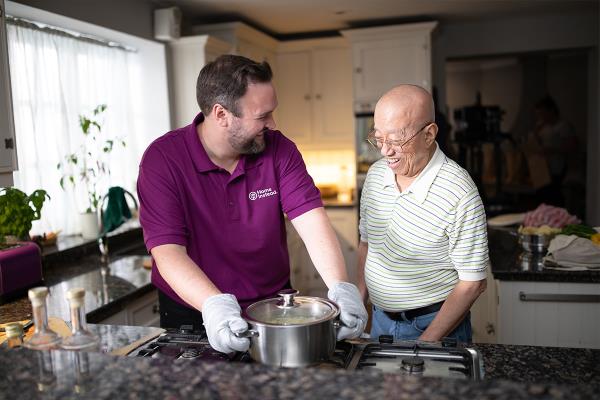
Arranging a holiday schedule can be overwhelming. Why not seek help from family and friends or hire a companion such as a CAREGiver from Home Instead Senior Care. CAREGivers can help you plan your holiday schedule and menu to keep you on track during this hectic season. A CAREGiver also could accompany you to holiday events, help with shopping and errands, as well as light housekeeping and meal preparation.
Put Safety First When Decorating Seniors' Homes
Q. My parents, who are both in their 80s, are expecting a houseful of people this holiday season. Guests will include a number of small children. My folks haven't entertained youngsters for years. I'm helping them decorate their home for the holidays as well as purchasing gifts for their young guests. Can you give me some suggestions how to make sure their home and their gift-giving are safe?
Decorating for the holidays is a wonderful tradition that you can continue for your parents now that it may be difficult for them to handle that task themselves. And they should be especially happy to know that all that hard work will be enjoyed by children.
Youngsters can make the holidays particularly fun. Following, from the American Academy of Pediatrics (AAP), are tips that can contribute to a safe holiday for young guests:
- Take special care to avoid decorations that are sharp or breakable; keep trimmings with small removable parts out of the reach of children to avoid the child swallowing or inhaling small pieces; and avoid trimmings that resemble candy or food that may tempt a young child to eat them.
- Remove all wrapping papers, bags, paper, ribbons and bows from tree and fireplace areas after gifts are opened. These items can pose suffocation and choking hazards to a small child or can cause a fire if near flame.
- To prevent both burns and electrical shocks, don't give young children (under age 10) a toy that must be plugged into an electrical outlet. Instead, buy toys that are battery-operated.
- Children under age 8 can choke or suffocate on uninflated or broken balloons. Remove strings and ribbons from toys before giving them to young children.
- Clean up immediately after a holiday party. A toddler could rise early and choke on leftover food or come in contact with alcohol or tobacco.
- Keep a laminated list with all of the important phone numbers you are likely to need in case of an emergency. Include the police and fire department, a pediatrician and the national Poison Help Line, 1.800.222.1222.
Your family can also make your holiday safer and more enjoyable with extra help from Home Instead Senior Care. The company's CAREGivers are screened, trained, bonded and insured and could assist you and your parents with many tasks such as food preparation, light housekeeping, errands and shopping.
Take Time for Yourself to Avoid Holiday Caregiver Stress
Q. As a working mother of three children and caregiver to two senior parents, the holidays are among the most stressful times of the year for me. I'm a good manager, so I always get everything done, but I end up frazzled and unhappy by the time it's all over. What are some things I can do to better manage my stress during this busy time.
Holidays are hectic no matter what, but adding caregiving responsibilities to the mix makes that equation more difficult to balance. More than half (55 percent) of the family caregivers who call upon help from Home Instead Senior Care appear to have average or significant levels of stress, according to a national survey. We imagine that percentage skyrockets for some by the end of the year. So here's what you can do:
- Exercise is vital. If you don't have time for regular workouts, figure out ways to add movement and exercise into your routine. Walk to the mailbox to send your cards, park opposite the mall entrance or use the stairs instead of the elevator to shop. Ideally, carve out at least 20 minutes three times a week for an activity that you enjoy.
- Proper diet is a must. It's tempting to eat too much junk and sugar during the holidays. Try to maintain a regular healthy diet full of fruits and vegetables.
- Do something special for yourself. While it may sound frivolous, make time during the season just for you. Get a massage, lunch out with a friend or go to an afternoon matinee movie while the kids are in school.
- Children under age 8 can choke or suffocate on uninflated or broken balloons. Remove strings and ribbons from toys before giving them to young children.
- Ask for help if you need it. Did you know that, according to a Home Instead Senior Care survey, 72 percent of adults who are currently providing care for an aging loved one do so without any outside help? To allow time for yourself, ask a neighbor or friend to pick up your kids from school so you can go to lunch or see that movie. If your parents need help, call a friend or neighbor, or consider hiring a CAREGiver from Home Instead Senior Care. CAREGivers are screened, trained, bonded and insured and often provide respite care to busy family caregivers.